Kaboose
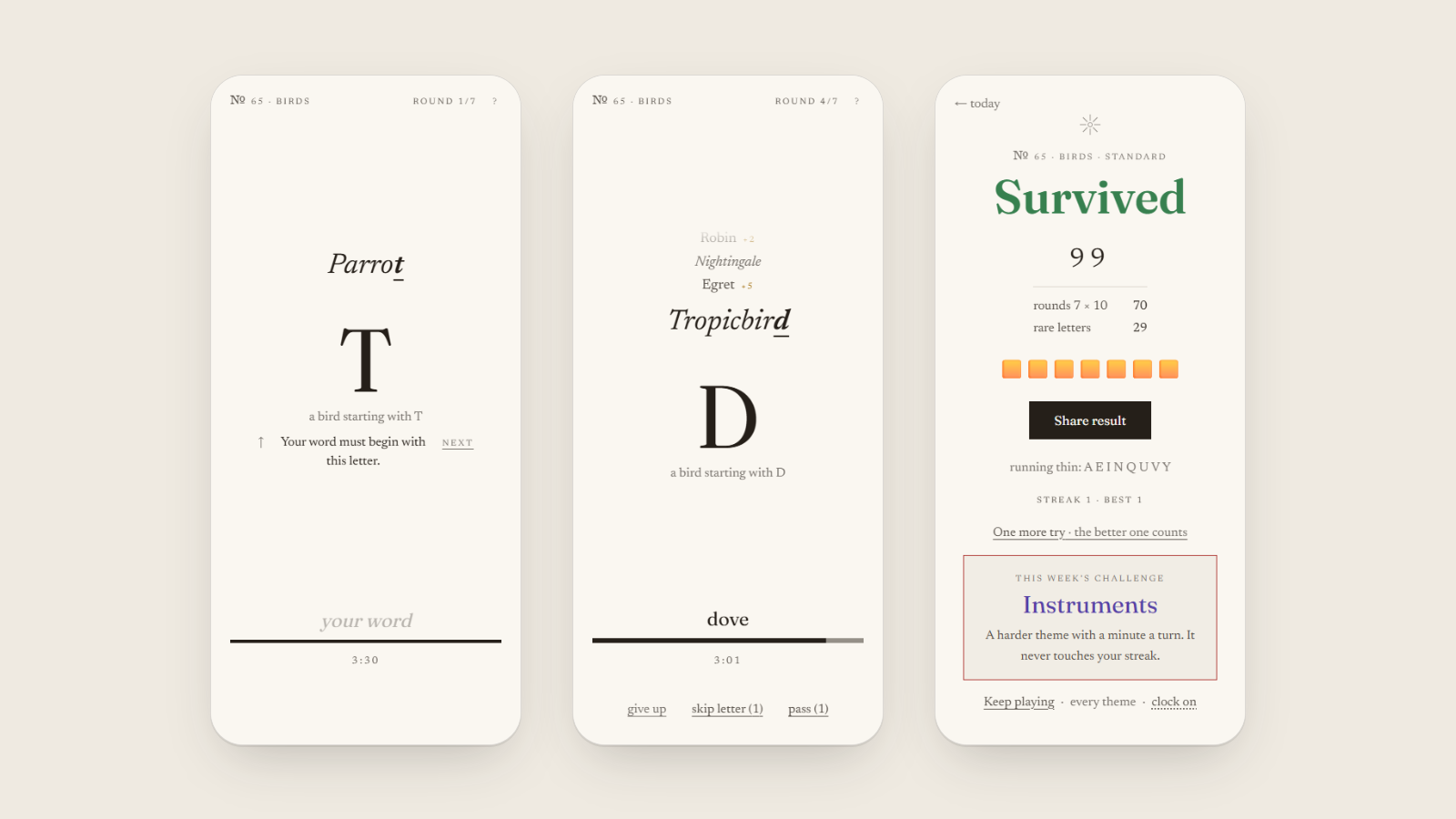
A daily browser word game. Everyone in the world gets the same theme each morning, and you trade words with the machine: each one has to start with the last letter of the one before. Seven rounds, one shared clock, two tries a day. I designed it, built it, and keep tuning it from what players actually do.

Why it exists
Daily puzzles work because everyone plays the same one and compares notes after. Most of them are solo, though, and most word games test spelling more than knowledge. Kaboose is a duel: you against a machine that knows every word in the theme, on a puzzle the whole world shares. The hard part was never the code. It was making a machine opponent that feels fair to a person who only knows the common words.
Key decisions
Measuring the player, not the machine
Every playtester said it was too hard. The data showed why: my quality checks measured whether the machine could keep going, never whether a person could.
The first version launched with twelve rounds, a 30-second clock per turn, and sudden death on any dead end. Everyone who tested it enjoyed it and everyone said it was too hard. One message summed it up: "today was instruments and nobody I know could name more than two."
So I measured it. The machine was steering players onto letters they couldn't answer, at every difficulty. On Instruments, a third of a Standard player's turns landed on N, where the only words left were things like Ngoni and Nyckelharpa. Casual wasn't kinder, just sloppier. Every automated check I'd built asked whether the machine could keep the chain alive. None asked whether a person could.
The rebalance cut twelve rounds to seven, pooled the clock into one bank for the whole game, and turned a dead end into a burned round instead of game over. The machine now prefers handing back letters a person can answer. I added a check that simulates a player who only knows familiar words, and every rule value now lives in one versioned object stamped on each analytics event, so before-and-after players are never averaged together.
The first game teaches itself
Playtesters walked past the "How to play" button in all three places it lived. So the rules moved into the first game instead of beside it.
A rules page nobody opens doesn't exist. New players now get three short screens that explain the chain, the letter, and the clock (you can go back, but not skip ahead), then three one-line coach marks on their very first turn: "Your word must begin with this letter." "Type your answer here. Enter sends it." "This line is your clock for the whole game. Spend it well." The game pauses while each one is up. Anyone with a game already in their history never sees any of it.
Watching first games also surfaced a smaller bug with a big cost: an error message used to replace the countdown for the rest of the turn, at exactly the moment a player most needs to know how long is left. The timer got its own permanent spot, and the clock line went from 1px to 4px so it reads at a glance on a phone.
AI at build time, never at play time
A language model checks every theme word before it ships, so the machine stops playing words that don't belong, and nothing a player knows gets rejected.
Word lists built from frequency data have a blind spot: frequency belongs to the spelling, not the meaning. "Lead", "Plant" and "Rat" sat at the top of Jobs. Sports once opened a game on "Bathe". Every one of those was found by a player, many through a "this should count" button I'd added to the results screen, which lets players flag a real word the game refused with one tap and no typing.
The fix was a model acting as a judge. At build time, Claude answers two questions about every word: does it belong to the theme, and how easily would a typical person recall it? Sixteen themes, nearly 11,000 words, under $3.50 in total. I reviewed by hand the 249 words the machine would lose and kept 148. The answers are saved, so nothing calls a model while you play. The machine only plays words that belong and that people know. Players can still type every word, because a rule that rejects something a person knows is exactly the unfairness the rebalance was fixing.
Where it landed
Kaboose is live and has had a new puzzle every day since launch. It's still small: so far the players are mostly people I've sent it to, which means the next problem is distribution, not design. The instrumentation is in place for when that changes, with every event tagged by rules version so I can tell which change did what.
- Live daily at kaboose.io since August 20, 2026
- 25 themes: 18 in the daily rotation, 3 weekly Challenge themes, and a Practice mode
- Rules rebalanced from playtest findings within three days of launch, then versioned for clean before-and-after analysis
- Every theme word checked by an AI judge at build time, then reviewed by hand
- Roughly 1,000 automated tests, including fixed-seed snapshots that keep the daily puzzle identical worldwide